Wankhede Stadium. Twenty20 centuries. AB de Villiers 1- Chris Gayle 1.
While Gayle grooved his way to an undefeated hundred in his first T20I game at the venue onWednesday, de Villiers' T20 ton, a frenetic 59-ball razzle dazzle, had come last year in an IPL game here. The reason why it seems like a faint speck in the memory vault is because of what de Villiers did in his next match at the Wankhede five months later.
In October last year, de Villiers' 119 off 61 balls helped South Africa rack up 438, beat India by 215 runs and clinch the ODI series 3-2. That knock even proved to be the trigger for a tiffbetween India's team director, Ravi Shastri, and the curator.
England's bowlers have the unenviable prospect of dealing with Gayle and de Villiers inside three nights. If de Villiers lines up an appropriate riposte to Gayle's masterclass, they could be at the receiving end of his third successive hundred in Mumbai. Jos Buttler felt they were "two great players," and that de Villiers's relatively wider range of shots was offset by Gayle's power.
In contrast, South Africa captain Faf du Plessis did not dwell too much upon their contrasting styles, but weighed in on what made de Villiers the dangerous batsman he was. "The fact that what makes him [AB] so good is he doesn't rely on one or two areas," du Plessis said. "And generally that comes with more on difficult wickets. As a batsman the more options you have [the more] you can be successful."
He also drew parallels in the way both the batsmen went about plundering runs in unhurried fashion. "Obviously Chris has been a master T20 batsman out for a while. All the IPLs here, he has worked hard when to go and when not to go," he said. "That [being in the zone] happens a lot more [to him] than it does for us normal people. That's his key as a batsman. You can almost hear from the side when it is coming. He just sits and waits, and at the specific bowler on the day he targets him.
"But [Gayle and de Villiers are] two completely different players, and both need the same [qualities], I suppose, to succeed. There has to be an element of setting yourself up as a batter. You never really see Chris go from ball one and start smashing. That's the same with AB. He plays at his best when he assesses the conditions and sees what the bowlers are all about and when he gets that sniff he becomes really hard to bowl to."
South Africa have won only one of the four ODIs they have played at the Wankhede and will be playing their first T20I at the venue on Friday before taking on Afghanistan on Sunday. But du Plessis has pleasant recollections of the stadium as well, having scored a century along with de Villiers the last time South Africa played here. He reckoned it was the best place to launch their campaign given the similarities of its conditions with those back home, and that spinners might not have a big say.
Faf du Plessis - "Wankhede is so much very close to our conditions back home so it's a great place to start" © AFP
"Wankhede is so much very close to our conditions back home so it's a great place to start, obviously the people, great crowd. I suppose you can compare it to the Wanderers in South Africa. Not a lot of our guys would have had the opportunity to play T20 cricket on a stadium like this, so we are really.
"I do feel that this is one of the grounds in India where there is a bit in it for the bowlers as well. There is a bit of bounce, bit of swing, ball travels, the wicket is good. The spinner is not as much as in the game as they would be in other grounds in India. We had a warm-up game here and we have a pretty good idea what will work."
In the lead-up to the World T20 South Africa have alternated between Hashim Amla and Quinton de Kock to open with de Villiers. Du Plessis admitted he had not worked out exactly what combination to field on Friday, and said the batting order was unlikely to remain the same throughout the tournament. "I have to look at different grounds and different conditions and see almost where the danger period of the game lies in and where it is the easiest time to bat," he said.
"For me the most pleasing thing is the fact that we have got guys in form. We have said before that we will try and adapt our batting line up to see which guys are in form and try and put them into different places. I don't think it will be fixed in the World Cup. Obviously it's different playing our first two games here at Wankhede and then we are in to Nagpur which is obviously a completely different wicket. Then we will have to see if we want to change our batting line up."
Du Plessis was also quite satisfied with South Africa's white-ball form going into the tournament, despite losing the T20 series against Australia. "If you have guys in form it generally takes stress off your performances as individuals and players. Generally 90-95 percent of the squad feels like they are playing really good cricket," he said.
"We have been consistent as a team, I think we are No.2 in the world now. For me it's really important when you come to these [tournaments] you have to put yourself as one, two or three. That shows you are consistent. The teams that have won the World T20s have been sides that have been right up with their performance throughout the year or two leading up to the tournament."


He was, however, wary of potential banana peels in their way after what happened to India against New Zealand in the opening match of the Super 10s, and said South Africa could ill afford to be complacent given the brevity of the tournament. "You can never ever disrespect any other team no matter how small they might look. I certainly learned the hard way in the 2011 World Cup. New Zealand looked like they were the minnows, they didn't play their best cricket and they smashed us in the quarterfinal. I have learnt that never again you can look at a team like that."

Pakistan's T20 captain Shahid Afridi has played down the focus on the team's security in India, saying he cherishes the support and appreciation of Indian fans. Team-mate Shoaib Malik also backed Afridi's statement, saying the security in India is "very good".
The players spoke to the media after arriving in Kolkata on Saturday, where they will play India on March 19. The game was scheduled to take place in Dharamsala, but was moved to Kolkatadue to concerns over the security of the Pakistan team. A three-member delegation from the PCB visited Dharamsala and formally said 'security is not assured' at the venue. The controversy also delayed the departure of the men's and women's teams to India.
"I've not enjoyed playing anywhere as much as I have in India," Afridi said. "I am in the last stage of my career and I can say that the love I have got in India is something that I will always remember. We have not got this much love even from Pakistan.
"There are cricket-loving people here, much like in Pakistan. Overall, I've enjoyed a lot playing in India in my cricketing career."
Malik, who is married to Indian tennis player Sania Mirza, said he had never faced security issues on his previous visits to India.
"Firstly I would like to thank the Indian Government. The security is very good," Malik said. "My wife is from India and I come to India a lot. I have never faced any security issue.
"I don't really see any difference between Pakistani people and the Indians. We eat the same food, we speak the same language. I don't really see any difference. I am very happy to be in India. I have always got a lot of love from people and from media."
Malik went on to state that Pakistan could benefit from the underdog tag they carry going into the World T20. He said the team could draw inspiration from the 1992 World Cup and the 2009 World T20, which Pakistan won despite low expectations from the public.
"It's good that we're underdogs and that gives you a lot of confidence. At the same time, we are here to do well," Malik said. "Let's talk about 1992 World Cup first. People were not expecting us to do well and win it but we won that. Same thing happened in 2007 World T20 when we did well before losing to India in the final. In 2009, we were not that big as a team but still we won. The same is the case going into this edition."
Pakistan, who are ranked No. 7 in the T20 rankings, have had a poor run of form in the format recently, with series losses against England and New Zealand. They lost crucial matches against Bangladesh and India in the recent Asia Cup and failed to make the final. Five of the side's nine T20I victories in the past 12 months have come against Zimbabwe and UAE.
Moreover, the World T20 squad was also in flux. Pakistan were forced to make changes following injuries to Babar Azam and Rumman Raees, while Khurram Manzoor made way for Ahmed Shehzad after a disappointing run in the Asia Cup. Khalid Latif replaced Iftikhar Ahmed in the World T20 squad.
"We could not deliver as per the expectations in the Asia Cup," Malik said. "It's part of life, we are professionals. Whatever happened has happened. We are here to give our best. It is a new tournament. We will try to help each other out and will try what is best for us."


Australia captain Steven Smith has hinted that David Warner could have a fluid batting position in the World T20 despite his recent success at No.4. Australia experimented with Warner in the middle order in the T20I series against South Africa and reaped instant rewards. In the second T20I, he smashed 77 off 40 balls in Johannesburg and was involved in a record 161-run stand with Glenn Maxwell as Australia nailed a chase of 205. Warner's role in the decider in Cape Townwas also crucial, as his 27-ball 33 complemented Smith's knock in propelling the team towards the target of 179.
Australia tried out three different opening combinations in South Africa using Aaron Finch, Shane Watson and Usman Khawaja with varying degree of success. Smith also suggested that the batting order could be altered to facilitate a left-right combination in spin-friendly conditions. By Khawaja's own admission, he isn't a certainty in the playing XI but Smith asserted that Australia's batting order wasn't cast in stone. "We have obviously got a lot of guys that can bat at the top of the order and he [Warner] has fitted in quite well at No.4," Smith told reporters at his arrival press conference in Kolkata.
"That doesn't mean he's going to bat at No.4 in this tournament. I think for us it's about being flexible and summing up the conditions and who we are playing against and try to match up as well as we can. But he certainly did a very good job at No.4 as well."
Australia have tried out a number of players before eventually settling on the fifteen they have for the World T20. There is a fair bit of inexperience in the squad as well with Peter Nevill, Ashton Agar and Adam Zampa having a collective experience of six T20Is. Smith, however, reckoned a "squad mentality" would help overcome such limitations and that the 2-1 series victory in South Africa was perfect preparation ahead of the World T20.
"We feel pretty settled. We have got 15 guys that can give this tournament a real shake, and I thought we played some pretty good cricket over in South Africa to win that series there," Smith said. "South Africa produced some wickets that sort of replicated these conditions as much as they could which was nice and guys have stepped up and are in good form.
"We've got a good squad together and it's going to take squad mentality for us to do well in this tournament. Selecting the best XI comes down to a lot of different things - who we think is going to be best suited for each opposition at each ground we play at. I think we've got 15 guys that can all do a job in these conditions."
Smith also defended the inexperience in his spin attack and was particularly pleased with Zampa's evolution as a leg spinner. Zampa is yet to take a wicket in two T20 internationals but he bowled economically in South Africa, giving away only 6.12 runs an over.
"I don't think our young spinners are a weakness at all. They are very confident in the skill sets and they have proven themselves and have bowled really well in the big games," he said. " I think he [Zampa] has improved a lot over the last couple of years. I thought he bowled beautifully in South Africa, thought he bowled really well in the ODIs he played in NZ as well.


"I've seen him play for a long time. I know his skill set very well. That helps a little bit when you're captaining someone you've pretty close to. He's got a lot of variations, he reads the batsmen very well which is very important in this format of the game and he is very confident in his skill sets. Hope he can have a good tournament for us."

Afghanistan earned the right to a third appearance in the main draw of the World T20 with a comprehensive win over Full Members Zimbabwe in what was a knockout to advance to the next round. Mohammad Nabi's career-best 52 helped Afghanistan recover from a mid-innings wobble and build on a strong start to post a total Zimbabwe never looked capable of chasing.
After two scrappy wins in the qualifiers, Zimbabwe were given their biggest task when Afghanistan took on their bowling and then demanded a highest-ever successful chase from them. Although Zimbabwe's top order did not fold as dramatically as it had in previous appearances, they could not keep up with the required run rate, especially against an attack that strangled them with spin.
Afghanistan had set Zimbabwe a similar target in January in Sharjah. Then, Zimbabwe got close thanks to a fiesty fight from Malcolm Waller. This time, like the rest of his team-mates, he was troubled by turn and found it difficult to score freely.
On a slow and sticky surface, Afghanistan started off as aggressively as they have done all tournament as Mohammad Shahzad took on Tendai Chatara and Donald Tiripano. He swung hard no matter what the length or line and tripped himself up when he reverse-swept Sean Williams straight to point. By then, Afghanistan already had 49 runs, of which Shahzad had scored 40, in under five overs.
Zimbabwe conceded just 24 runs in the next five overs and could have had Mohammad Nabi stumped on 20 when he charged against Wellington Masakadza but the ball popped out of Richmond Mutumbami's gloves. They also thought they had Samiullah Shenwari caught at deep midwicket for 17 but Waller's low diving catch was referred to the third umpire who decided to rule Waller not out. The pair got some luck and rode it.
They put on 98 runs for the fifth wicket and 52 of those came after the 15th over, after which Nabi punished short balls from Masakadza and Shenwari pulled Tinashe Panyangara's figures out of shape. Zimbabwe were unable to stop the bleeding even when Shenwari holed out to deep midwicket and Nabi was run-out after reaching fifty, and conceded 28 runs in the last two overs.
Hamilton Masakadza and Vusi Sibanda approached their chase conservatively. The first boundary only came in the third over when Masakadza deposited a Dawlat Zadran ball over deep square leg but his aggression did not last long. He tried to do the same thing to Hamid Hassan but missed a full and straight delivery and was bowled.
Sibanda seemed ready to adopt the more responsible role he played in the first match against Hong Kong but Afghanistan had an ace up as their sleeve. As soon as the Powerplay ended, 17-year-old legspinner Rashid Khan was brought on. Sibanda swept and top-edged to give Hamid a simple catch. Mutumbami holed out, as he had done in every innings in the qualifiers so far, in the next over for 10. Williams and Waller were rebuilding slowly but with every delivery they did not score off, they were actually costing Zimbabwe. They limped to the halfway stage on 58 for 3.
Waller played down the wrong line to Shenwari and was bowled before Rashid had Williams stumped and Zimbabwe's fight was over. Shenwari, Rashid and Nabi continued to confound Zimbabwe's batsmen with spin, so much so that none of their batsmen managed to get past 17 runs, and the one who did - Panyangara - was just having some fun as the end loomed. Zimbabwe lost their last five wickets for 37 runs and were booted out of the tournament before it has even really started for the second time.


In 2014, too, Zimbabwe had failed to qualify and a successive failure will raise questions about the quality of their cricket. In the end, the team that is most likely to challenge the big boys, Afghanistan, have rightful reason to celebrate.

Jason Roy is aiming to combine his free-spirited batting with "tactical nous" as he and England seek to put behind recent limited-overs defeats in South Africa going into the World T20. England went down 3-2 in the ODIs - after holding a 2-0 lead - and lost both their T20 fixtures, but have started their build-up to the World T20 with a rousing six-wicket win over New Zealand. Roy's 36-ball 55 set in motion England's racy chase, and he hoped to replicate that touch without going for broke every time.
"I have got to realise I need to give myself time, I'm not a robot," he said. "It is [fun to go flat out] when you stay in longer than 10 balls. As well as enjoying myself and whacking it I need to give myself a chance, work hard and accumulate runs. A bit of tactical nous instead of just trying to bludgeon the ball is something I have learned a huge amount about in the last two and a half weeks. Mentally I have been getting myself ready for that back at The Oval."
"The ball came on nicely," he added of his productive start in India. "It was my first experience of playing T20 cricket at this stadium. The seamers were coming on nicely in the first few overs. The boundary being smaller one side helped."
Roy managed a meagre 96 runs from five ODI innings in South Africa and scored 15 and 9 in the T20Is but his role in the limited-overs set-up has been defined more by the impact he can provide at the top along with Alex Hales. Roy, however, admitted to being weighed down by the pressure of having to live up to such an image during the South Africa series where he felt England were "mostly poor."
"It's a nice role to have, however you can put too much pressure on yourself like I did in South Africa," he said. "I put too much pressure on myself to go out there and whack it from ball one. I think I might have expected myself to score more runs than I did and I didn't really reach my expectations as well as I should have.
"I should have just freed myself and enjoyed myself instead of expecting to get runs. That's what I'm doing now, just going into each game and going ball by ball. I don't want to think about the game the night before or on the morning. I just want to have no pre-conceived ideas and not think too far ahead. My expectation was I was playing the bowlers before the game started I was doing that wrong.
"We didn't really do as well as we had hoped in South Africa. We played some poor cricket in amongst some good cricket, but mostly poor. The next couple of weeks are huge for us to turn it round. The squad's been really gelling well together and the training has been high intensity."
Roy dismissed suggestions of insecurity over his place in the side and spoke about the futility of looking over the shoulder, saying it would only reflect poor work ethic. "If you are questioning your place, you are not working hard enough," he said. "I just take each game as it comes and work as hard as I can in the nets. If I'm not picked, I'm not picked and there's another player who has earned himself the right to play instead of me. I'm never kind of too worried about whether I'm going to be picked or not."
He said England would aim to sustain the intensity displayed during the New Zealand game as they play a local side, which will feature a few players from the English squad, at the Brabourne Stadium on Monday.
"It doesn't really matter who you are playing against, it is just the environment of being in the middle of the stadium and taking it in, and there are four of our guys playing against us so no doubt they will be putting a huge shift in too. We have had inter-squad games and it does get very feisty, very aggressive. You might fall out for the night but we're all mates so it's all good."
From an English perspective there has been a significantly warmer attitude towards the shorter formats of the game following the appointment of Andrew Strauss as the director of England cricket. That Strauss has encouraged coaches and players to partake of the experience of overseas franchise T20 leagues augurs particularly well for the likes of Roy and Hales who have built their reputation in white-ball cricket.
"It's just that in the next few years you have got a huge amount of one-day cricket and Twenty20 cricket coming up. Especially now with the World Cup, we are realising that white-ball cricket is important now. And the more experience the better, the boys getting up to the IPL, playing there and playing all over the world is only positive. There probably is a bit of a change.


"My first Lions tour was to India, a lot of A tours have been played in the sub-continent, we went to Dubai, won against Pakistan. So we've made huge improvements and huge headway and the next couple of weeks will show just how much headway we have made."

Hong Kong tied themselves into knots against Mohammad Nabi, and how. Their lack of application on slow turners, typical of the subcontinent, stood exposed as Afghanistan bossed their way to second successive win, this time by six wickets, to set up a knockout against Zimbabwe which will determine the Group B qualifier for the Super 10s.
Hong Kong, who opted to bat, raced away to 40 without loss, before the sight of spin induced a sense of panic and desperation in their ranks. Four wickets in four overs, two of those being Babar Hayat and Mark Chapman, the latter to a superb yorker from Gulbadin Naib, had Hong Kong short-changed even before the halfway mark of their innings. They then huffed and puffed to 116 for 6 on the back of Anshuman Rath's industry, an unbeaten 31-ball 28, a total that was 40 short of what Tanwir Afzal, the captain, hoped to get.
Hong Kong's slim chances from that point were pinned on regular strikes at the top by their new ball bowlers. Once that didn't come, the game was reduced to being a cakewalk for Afghanistan. They rode piggyback on Mohammad Shahzad's 41; a typically robust innings that had all his typical elements as Afghanistan won with two overs to spare.
Ryan Campbell, who struggled for timing on his Hong Kong debut two nights ago, went out with a 'high-risk, high returns' approach, and found his hitting range early on as he muscled five boundaries. But predetermining his shots came back to haunt him as Nabi's slow turn beat him in an attempted sweep as the ball bounced back onto the stumps. Two balls later, Hayat was deceived in flight as he chipped a simple catch to cover.
The purchase on offer for Nabi forced another change as Rashid Khan, the skiddy legspinner, was summoned, and he made an impact immediately courtesy of his mix of googlies and sliders. Hong Kong's batsmen suddenly started playing for demons that weren't there on the surface as the slower men scythed through the middle order, with the continuous loss of wickets making run-making difficult.
Amidst the carnage, Rath nudged his way by playing with soft hands, and using deft touches to push his team to where they finished with. Nabi, whose 4 for 20 handed him the best figures by an Afghan bowler in T20Is, led them off the field.
The momentum they gained after a top class display of death bowling was carried forward with the bat; Noor Ali Zadran's straight boundary off the first ball he faced revving up Afghanistan. With little swing or nip off the surface, the pacemen resorted to gentle off-cutters. Afzal then turned to spin in the hope of doing to Afghanistan what Nabi and Rashid Khan did to them. But the batsmen's application thwarted their designs.
For a change, it was Noor Ali who did the early running by showing why a simple approach relying on timing, and not just brute force, can be rewarding in a T20 game, especially in a small chase. But to their credit, both openers didn't miss out on long hops either as Afghanistan wiped out 43 in the first six overs. With the groundwork done, both batsmen began to express themselves freely, until overconfidence got the better of Shahzad, who holed out to long-off for a 40-ball 41 to give Campbell his first T20 wicket.
Nabi and Noor Ali then milked the bowling as the spinners went through their motion, hoping for mishits and poor shot selection to help them pick up wickets. They brought the target down to 22 off 34 balls before an ungainly slog ended Nabi's stay. Two balls later, Noor Ali was run-out courtesy Hayat's flat throw from the deep. Having done all the hard work, gloss was further taken away from Afghanistan's chase as Shafiqullah was out bowled to an attempted slog.


But three wickets in quick time did very little to lift Hong Kong, whose muted celebration was a giveaway that it wouldn't have really affected the big picture. Gulbadin Naib then polished it off with two classical drives and a neat tickle down leg side as Afghanistan completed an easy chase with plenty to spare.


For all the unwanted accolades Russell Domingo earned this summer - he oversaw South Africa's longest winless streak in Test cricket since readmission in which they were also bowled out for their two lowest scores - he remains their most successful major tournament coach and therein lies the chance for him to declare this season a success. Domingo has been in charge for two ICC tournaments, the World T20 in 2014 and the 2015 World Cup. South Africa reached the semi-finals in both tournaments and he has reason to believe they can go one, or even two better at the World T20 in India.
"We've got a chance. We are one of the most consistent sides in this format. We can go there very confident," Domingo said on the eve of South Africa's departure for India. "We have prepared very well. We have some of the best players in the world. We've got a seriously good side. We'll be there and thereabouts."
South Africa signed off on their home season with a 2-1 series defeat to Australia, but victories over England and India in In`dia in the shortest format would seem to put them among the favourites. However, a difficult few months headlined by Test defeats and talk of AB de Villiers' workload management means they will fly under the radar for a change and Domingo is quite happy with that. "We are all pretty chilled. I don't think there is a weight of expectation around our team or any of the teams because of the nature of the competition," he said.
The structure of the tournament - two groups of five teams with each team playing each other only once - means the chances of slipping up are greater, so Domingo is encouraging his team to "keep it simple," and not look for a special formula. "You can't get too fancy, you can't get too funky. There is no magic wand to wave. The sides that do the basics really well in high-pressure games, they usually come out on top," he said.
South Africa were that side for five successive limited-overs matches at home when they came from behind to beat England 3-2 in an ODI series and win the first two T20s. All those wins and the first against Australia came chasing, which has allowed South Africa to bury one ghost but resurrect another. "We've chased really well which is a big bonus but we need to defend a score. We need to find ways of scraping," Domingo said.
Domingo's way of helping them find that is to ensure they have clarity of thought rather than an overload of technical expertise. "I can't hit my players if they bowl a no-ball, or slap them on the wrist," he said. "If you make a mistake, the last thing a player wants to hear is, 'Why did you bowl that?' Encouraging them and working on their thought processes is the key. If your thoughts are clear you have got a better chance of executing your plan."


Faf du Plessis has already bought into that philosophy and emphasised that the fundamentals should be South Africa's focus as they head to into the World T20: "This team has had really good results in the subcontinent but we've got some of work to do to make sure we are ready for that first game. We've got to work on the basics."

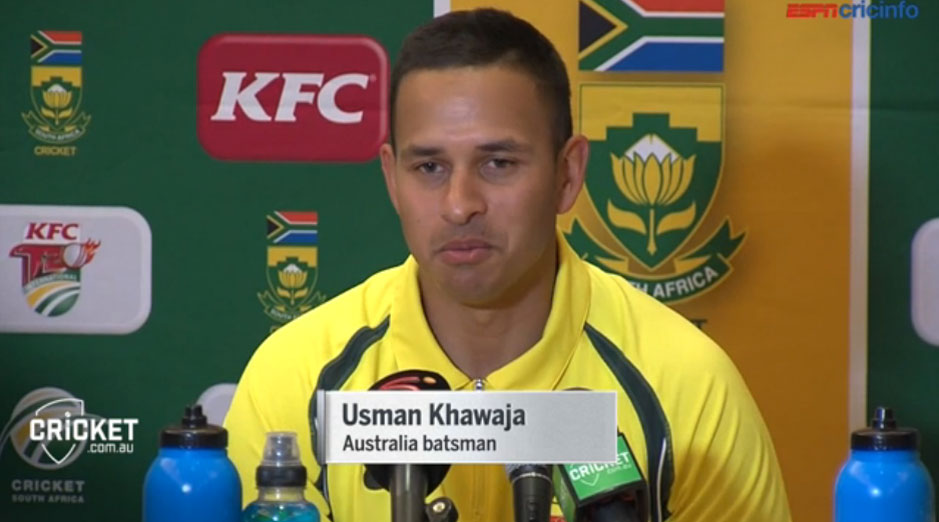
Usman Khawaja might be one of Australia's most in-form players in any format, but he does not necessarily expect to be part of the starting XI for the World Twenty20 in India. Khawaja opened the batting and scored 33 from 25 balls in Australia's win over South Africa in the third T20 in Cape Town on Wednesday, a win that secured them a 2-1 series victory.

But in none of the three games did Australia use the same opening combination, instead testing all options ahead of the World T20, with David Warner set to stay down the order. In game one, Khawaja opened with Aaron Finch, in game two it was Finch and Shane Watson, and in game three Watson and Khawaja were used as the opening pair.
Khawaja only made his T20 international debut this summer but has been consistently scoring runs in every format at almost every level this season. However, Watson's all-round value and the experience of Finch, the No.1-ranked T20 international batsman in the world and until recently Australia's captain, could mean Khawaja misses out.
"We've got world-class players in our team," Khawaja said after the third match in Cape Town. "Finchy didn't play today and he's one of the best T20 players in the world, so we've got a lot of batting depth and strength.
"Finchy was there before I was, when I came into the team he was T20 captain. He's been there and done it, I was the player coming in. I sort of expect him to come back into the team. Then Watto's been such a great player for Australia, in particular with the white ball. His white-ball form lately has been great. He offers a lot with the ball too.
"The dynamics are pretty simple. We're pretty good mates off the field. I've known Finchy since I was a kid, we've been playing cricket together since we were kids, we're the same age. Obviously I play with Watto at the Thunder so it's a good relationship."
In the win at Newlands, Watson made 42, captain Steven Smith top scored with 44 at No.3, and Warner in his new middle-order spot managed 33 at No.4 to help Australia to victory. Most members of the squad were used in at least two of the three matches in South Africa as Australia sought to settle their preferred XI ahead of the World T20.
"First and foremost we won the series," Khawaja said. "We wanted to go into the World Cup on a winning note. It's always a little bit tougher when you haven't. The fact that we won is a big bonus. I think everyone just about in the squad has contributed somewhat in the last three games, which is nice."
Australia play a warm-up match against West Indies in Kolkata on Sunday, ahead of their opening match of the tournament proper against New Zealand in Dharamsala on Friday next week.


The ICC has shifted the India-Pakistan match to Kolkata because of security concerns in Dharamsala, but the PCB has reasons for not yet clearing the departure of its teams.


The PCB's decision to defer the departure of its men's and women's teams to the World T20 in India pending "an assurance against specific threats to the Pakistan team from various political parties and groups during the tour", is the end result of months of dissatisfaction over handling of India-Pakistan cricket ties in India.
The PCB's announcement came shortly after the ICC had conveyed its decision to shift the March 19 World T20 fixture between India and Pakistan from Dharamsala to Kolkata. The change of venue was expected to bring the controversy surrounding the match to an end; the PCB, however, said its teams would not travel unless they were given high-level assurances from India, following an adverse report by its security team which visited Dharamsala and New Delhi over the weekend. The three-man committee which assessed the security situation in Dharamsala described it as 'unsatisfactory.'
The delay of the Pakistani teams' departures is not a trigger-happy response by the PCB to events of the last 24 hours. It has built up over several months, and reached tipping point when a scheduled meeting in October between the PCB chairman Shaharyar Khan and BCCI officials was cancelled due to anti-Pakistan protests in the BCCI's Mumbai office. These talks had been arranged to discuss the possibility of a long overdue bilateral series, to be hosted by the PCB. Workers from the Shiv Sena, a regional political party, stormed into the BCCI office in Mumbai, shouting anti-Pakistan slogans. It led to an embarrassing departure for the Pakistani delegation led by Shahryar.
The incident led to the PCB losing confidence in BCCI's handling of what is always a delicate situation as well as public support against pushing for matches versus India. It made headlines in Pakistan, with the PCB being severely criticised by political and cricketing quarters. Taking note of the fiasco, the Pakistan government asked the PCB to adopt caution in travelling to India and to do so only after a favourable prior advisory from the centre. In the case of the World T20, neither India's central government in New Delhi nor the Himachal Pradesh state government were able to give any clear assurances about the security that would be put into place for the Pakistan teams.
The state government of Himachal Pradesh in fact categorically refused to assure full-fledged security to the Pakistan team in Dharamsala, citing protests by ex-servicemen's families following incidents along the border. Following that, the Pakistan security delegation's visit did not appear to be taken seriously by the Indian government either.
While the ICC had indirectly assured the PCB of full security, it was not accepted because the only direct word from any government in India had come from the chief minister of Himachal Pradesh, about being unable to protect the team. When the delegation got to Dharamsala, no security plan was presented to them and they had to insist on a meeting with the deputy police commissioner of the region. There, it is learnt, the delegation found that the deputy commissioner did not have any special instructions from the home minister around security for the Pakistan team.
In Delhi, no attempts appeared to have been made by the BCCI to arrange meetings with senior authorities in the central government. The Pakistan delegation spent two days in the Indian capital but were unsuccessful in attempting to establish contact with the Home Ministry to set up a meeting with the Home Minister.
These incidents have further soured cricketing relations between the two countries. The PCB's last two major dealings with the BCCI have been unsatisfactory and led to increasing mistrust. Towards the end of 2015, there was a lack of clarity over playing the bilateral series, with the series abandoned and the BCCI not responding to communiqués from the PCB. India's silent ditching of the bilaterial series, the PCB say had cost them US$40m.
The list of Pakistan's disenchantment over cricketing relations with India stretches back beyond cricket over almost a year. The Shiv Sena's protest in the BCCI office was preceded by the cancellation of concerts in India by two Pakistani singers, Atif Aslam and Ghulam Ali, in April and October 2015. A launch of a book written by former Pakistan foreign minister Khurshid Mahmud Kasuri, also in October, was disrupted by right-wing activists attacking one of the organisers with black ink. After more Shiv Sena protests, which occurred during South Africa's tour of India, Pakistani umpire Aleem Dar and commentators Shoaib Akhtar and Wasim Akram did not travel to Mumbai for an ODI and left the country instead.
All of these events have led the PCB to be more stringent about its security demands on the BCCI and the ICC about the World T20. In such a scenario, if these demands are not met, there is every possibility the PCB may consider pulling both squads out of the tournament.


From 29th in the world to beating Ireland on their World T20 debut in Dharamsala, Oman's success over the last year is no mirage.
They were all lined up like thoroughbreds bucking against the starting gate. They knew the shot was coming and they wanted to be ready.

Bang. Zeeshan Siddiqui pummels the ball over mid-off and the race was on. Oman may have justqualified for the World T20, but there was a small matter still to be decided.
"I think I was the first one to run into the ground when we won. Everyone was waiting [on the boundary] but I was the first one to go and lift the batsman up," beams Sufyan Mehmood. "It was the best moment of my life."
Oman have barely broken into international cricket. The World T20 qualifier in July 2015 was their first-ever televised match. They play one-dayers in Division Five of the World Cricket League, while their opponent Namibia had already been to a World Cup in 2003. David would have felt like Goliath standing next to them.
But underneath it all lay the biggest significance for Oman. In Mehmood. He is the only player in the squad at the World T20 who is native to the Gulf state. He is 24 years old and the promise he shows as a fast bowler should give him several opportunities at a repeat of that winning feeling. That bodes well for Oman. Homegrown talent is invaluable, especially for an Associate nation where football's pull makes cricket a distant afterthought.
Mehmood, however, had a leg up. His father had moved to Oman 40 years ago and married a woman from Pakistan. "Cricket is in our blood," he says.
Perhaps more kids from Oman might also pick up the bat and ball if his and his team's success in recent times - they beat Hong Kong on their Asia Cup debut in February - continues. Mehmood drew his inspiration from wanting to pick up a different object too, a rather coveted one. "When I started playing cricket, my goal was always to play in a World Cup."
Mehmood began his career playing school cricket. Then he made the cut for Oman Under-17s in November 2008, their U-19s in April 2009, then a national camp and voila, he was in the senior team too by the following November. He introduced himself in the Asia Cup in 2016 with a giant no-ball, but with the next one, he broke Rohan Mustafa's bat. Perhaps Mehmood misunderstood the meaning of "free hit."
*****
It was as recently as 2007 that Oman had to make do with pitches made of cement because they didn't have a turf one. Former captain and current team manager Jameel Zaidi takes pride in the fact that the team has played four World Cup qualifying tournaments - for the 50-over version in 2005 and 2009 and the 20-over version in 2012 and 2015 - with such limited infrastructure. They are in the main event now, having punched well above their global ranking that sat at 29 in July.
And they have a turf strip now, surrounded by a lush green outfield and recently added floodlights, at the Ministry of Sports complex in Al Amerat, about 20km away from the centre of Muscat. Only the premier division gets to play their matches there but there are plans to build a second turf ground at the complex to help the other domestic teams get a taste of conditions that prevail in international cricket. According to their official cricket website, there are five all-Omani teams in domestic cricket. Overall there are 58, and they are grouped into divisions from A through J.

Munis Ansari is among those who have played at the highest level in Oman for years now. With a slingy action like Lasith Malinga - "I've had it since my childhood," he insists when the comparison is made - he had been in line for a national cap in 2012, but had to wait a year longer to complete the mandatory four-year residence period put forward by the ICC.

Born in Sehore, Madhya Pradesh, Ansari reckons he could have played for India if he'd had some help in his formative years. "I used to bowl 140-plus," he says, but his hopes waned when he couldn't find a place in his state team for the Ranji Trophy. So he moved to Oman for work as the sales supervisor at Enhance Group of Companies.